UNC Pembroke Research Published in World’s Leading Alzheimer’s Journal
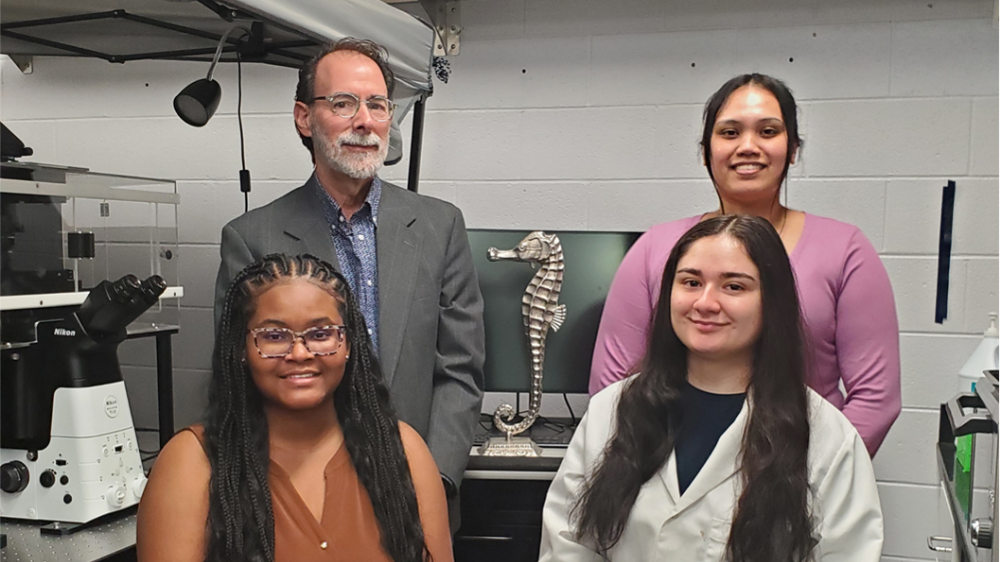
A research team led by Dr. Ben Bahr, the William C. Friday Chair and Distinguished Professor at UNC Pembroke, has achieved a significant milestone in Alzheimer’s disease research with a new study published in Alzheimer’s & Dementia: The Journal of the Alzheimer’s Association, widely regarded as one of the most prestigious and selective journals in the field.
The paper, titled “Ginseng extract improves synaptic resiliency: A key factor for healthy cognitive aging,” appears in a special anniversary issue honoring the nation’s Alzheimer’s Disease Research Centers (ADRCs). UNC Pembroke is a partner institution of the Duke University and UNC-Chapel Hill ADRC, one of only two such centers in North Carolina. The Bahr Lab is among many working tirelessly to understand why a healthy diet reduces the risk of dementia by 40-50%.
“This is one of the highest-impact journals in Alzheimer’s research,” Dr. Bahr said. “The review process is extremely rigorous, and very few papers are accepted. To have our work appear here is both an honor and a powerful statement about the quality of research happening at UNCP and our ability to form valuable collaborations.”
For one of the publication’s co-authors, UNCP alumna Morgan Pait, PhD, the research is more than an academic achievement. It is personal.
Today, Pait is not only a neuroscientist — she is also the full-time caregiver for her grandmother, Linda Franklin, who was diagnosed with Alzheimer’s disease in 2021.
“Dementia runs in my family,” Pait said. “My grandfather had Parkinson’s. My grandmother has Alzheimer’s. I was already doing Alzheimer’s research when she was diagnosed — but living it is completely different than studying it.”
Since earning her PhD from Wake Forest in 2023, Pait has put her career on hold to care for her grandmother, whose condition has steadily worsened. What she has witnessed has given her a front-row seat to the disease’s devastating complexity.
“One of the things that surprised me the most, even after doing Alzheimer’s research for so long, is how inconsistent the disease is,” she said. “One minute she knows who you are, the next she doesn’t. One minute she’s happy, the next she’s upset. It changes constantly. It wears on them — and it wears on the caregiver.”
Franklin, once an avid card player, puzzle solver and baker, can no longer perform even the simplest activities.
“She loved crafts, puzzles and sewing. Now she can’t do any of that,” Pait said. “She doesn’t know who her children are. She doesn’t remember being married, despite being married for 59 years. That part is heartbreaking. Those memories are gone.”
At 83, Franklin is now in the advanced stages of the disease.
“There are moments when there is nothing you can say or do to comfort her,” Pait said. “That’s one of the hardest parts of being a caregiver.”
Why This Research Matters
The study examines how plant extracts aid in protecting the brain by enhancing synaptic resiliency — the capacity of neurons to maintain healthy connections as we age. Synaptic connections are crucial for learning and memory and are among the first structures to deteriorate in Alzheimer’s disease.
Bahr’s team focused on a key protein clearance system known as the autophagy-lysosomal pathway (ALP), which functions as cleanup and recycling machinery in all the brain’s 86 billion neurons.
“For 30 years, my lab has studied how this protein-clearance pathway protects the brain,” Bahr said. “We screened a wide range of natural products and discovered that specific plant extracts activate this same protective mechanism. Along with Research Specialist Miranda Chebahtah, who brings years of veterinary technician and teaching experience to my lab, we are now exploiting the mechanistic pathway for drug discovery efforts.”
The researchers used living brain tissue cultures, which were maintained in the lab for months, to model early Alzheimer's-like stress and test the effects of natural compounds on neuronal health. They found that ginseng extract improved the integrity and stability of synaptic connections, also preserving brain function in an animal model of cognitive impairment.
The first author on the paper, Michael Almeida, conducted his PhD research entirely at UNCP’s Biotechnology Research and Training Center. Additional co-authors include UNCP graduates Pait, '15, Dr. Katherine Rentschler, '17,Christopher Norton, '18, and Bahr’s former research assistant Dr. Karen Farizatto.
The work reflects a powerful collaboration among UNCP, UNC Wilmington and the Duke–UNC Alzheimer’s Disease Research Center.
Training the Next Generation of Scientists
Undergraduate researchers at UNCP played key roles in the project, gaining hands-on experience with techniques rarely available at the undergraduate level.
“To be part of a study published in a journal of this caliber is a game-changer for students,” said Dr. Sayo Fakayode, associate dean of the College of Arts and Sciences. “They learn what it takes to produce research at the highest level, and having their names on a paper like this opens doors to PhD programs, medical school and industry careers.”
Fakayode said the publication underscores the university’s commitment to excellence.
“This is one of the highest-impact journals in the field — there are only a handful at this level,” Fakayode said. “To have UNC Pembroke represented here puts the university on the global research map. It speaks volumes about the rigor of the science, the strength of the mentorship and the opportunities our students receive.”
While the ginseng findings are significant, Bahr said they are only the beginning. His lab has already developed small-molecule drug candidates that activate the same protective pathway, leading to a patented Alzheimer’s-related technology in 2022 and a second-phase patent now pending.
With support from NCInnovation, Professor Bahr is launching his second spin-off company to commercialize this intellectual property and attract pharmaceutical partners.
“Our goal is to provide an effective and safe treatment that can be taken as a simple pill,” Bahr said. “In addition to a uniquely targeted therapy to be affordable and accessible, my team is also working to improve dementia awareness for a dementia-friendly society, especially for underserved communities.”
For Pait, the paper represents both professional achievement and personal hope.
“I can’t change what’s happening to my grandmother,” she said. “But if this research helps someone else catch the disease earlier or gives them more good years with their family, then it matters.”